
Kibbe Type Comparison
Soft Natural vs Soft Classic
Can't decide if you're a Soft Natural or Soft Classic? You're not alone—this is one of the most common points of confusion in the Kibbe system.
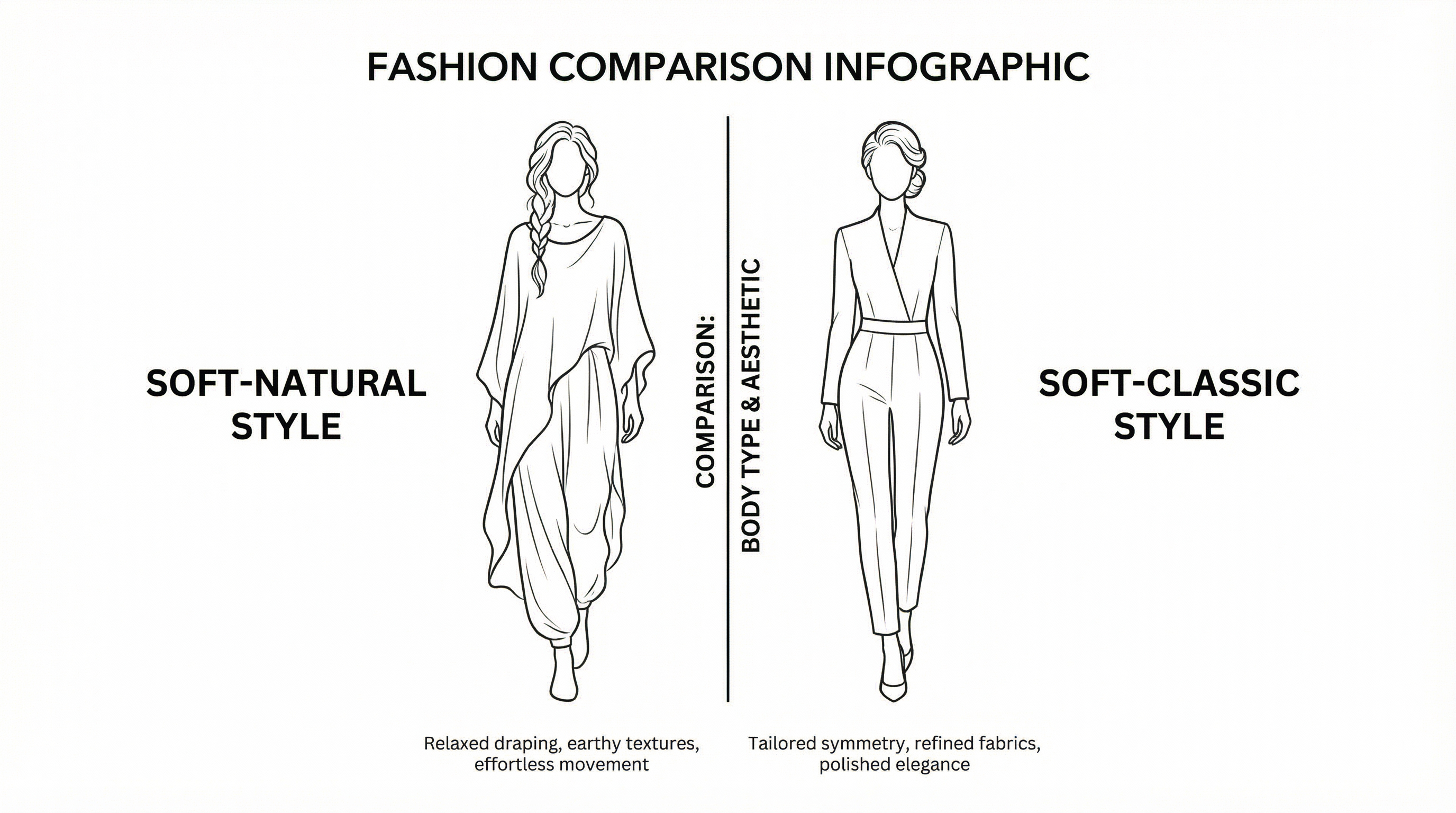
Soft Natural and Soft Classic are frequently confused because both types have "soft" in their names and share a yin undercurrent. However, these types come from completely different families with fundamentally different needs. Understanding the distinction requires looking past the surface-level softness to the underlying structure and overall impression each type creates.
Soft Natural
Soft Yang
Approachable and feminine. Soft Naturals blend the Natural's relaxed bone structure with soft, curved flesh.
Full Soft Natural GuideSoft Classic
Balanced with Yin influence
Graceful and refined femininity. Soft Classics combine Classic balance with a soft, feminine undercurrent.
Full Soft Classic GuideWhy Soft Natural and Soft Classic Get Confused
Both types share yin softness in their flesh—gentle curves, soft facial features, and a feminine quality. Both avoid extremes and sharp angles. But here's the key: they're soft for different reasons and in different ways. Soft Natural's softness is yin flesh over a yang (wide, blunt) frame—it's a contrast. Soft Classic's softness is a gentle yin undercurrent in an otherwise perfectly balanced package—it's subtle and uniform. This difference completely changes how each type should dress.
The Key Difference
The fundamental difference is balance versus width. Soft Classics are defined by their symmetry and overall balance—nothing is extreme, everything is moderate, with just a touch of softness. Soft Naturals are defined by their width—a blunt, slightly broad frame that requires accommodation regardless of the softness on top. Think of it this way: if you drew a Soft Classic, you'd draw a balanced, symmetrical figure with gentle curves. If you drew a Soft Natural, you'd draw a wider frame with soft curves draped over it. The impression is completely different even if both look "soft" at first glance.
Bone Structure: The Foundation
Soft Classic bone structure is moderate in every way. Shoulders are neither broad nor narrow—they're proportionate. The vertical line is moderate. Bones are neither prominent nor delicate—they're balanced. Everything about the Soft Classic skeleton says "middle ground" with no extremes in any direction. Soft Natural bone structure, while softened by flesh, has width and bluntness. Shoulders may be slightly broad or square. The ribcage may have width. There's an underlying sturdiness to the frame that you don't see in Soft Classics. Even in a Soft Natural with a moderate vertical line, you'll notice that blunt, slightly wide quality in the bones that Soft Classics completely lack.
| Soft Natural | Soft Classic |
|---|---|
Moderate vertical line | Moderate, balanced frame |
Slightly wide shoulders | Slightly soft edges |
Blunt bone edges | Symmetrical proportions |
Moderate frame | Moderate vertical |
Slightly square silhouette | Gentle slopes |
Body Flesh and Curves
Soft Classic flesh creates a gentle, even softness throughout the body. The curves are subtle rather than pronounced—a soft hourglass tendency rather than dramatic curves. The flesh distribution emphasizes the already-balanced proportions rather than creating contrast. Soft Natural flesh is similar in quality (soft, yin) but it interacts differently with the frame. Because there's width underneath, the flesh creates more visible curves as it softens those wider bones. A Soft Natural may appear more obviously curvy than a Soft Classic even though both have soft flesh, simply because the flesh is contrasting with a different underlying structure.
| Soft Natural | Soft Classic |
|---|---|
Soft, curved flesh | Soft, moderate curves |
Gentle curves at bust/hips | Even distribution |
Soft arms and thighs | Slightly rounded |
Slightly fleshy waist | Gentle hourglass tendency |
Rounded overall | Soft arms and thighs |
How to Tell Which Type You Are: Quick Tests
Look at your shoulders in a mirror. Are they perfectly proportionate to your hips, creating a balanced silhouette? That's Soft Classic. Do they have any width, bluntness, or squareness to them? That's Soft Natural. Try on a perfectly tailored, structured blazer with soft details (think: rounded lapels, soft fabric). Does it look polished and appropriate? You're likely Soft Classic. Does it feel too "done" or restrictive? Does it ignore the width in your frame? You're likely Soft Natural. Finally, consider your overall impression: Do people describe you as "elegant" and "put-together"? That's Soft Classic. Do people describe you as "approachable," "fresh," or "girl-next-door"? That's Soft Natural.
Celebrity Comparison: Seeing the Difference
Compare Jennifer Lopez (Soft Natural) with Marion Cotillard (Soft Classic). Both are beautiful, both have soft femininity, but the differences become clear when you look closely. J.Lo has width in her frame—her shoulders and ribcage have that sturdy, slightly broad quality, and she looks best in relaxed, flowy pieces that accommodate that width while showing off her curves. Put her in overly structured, polished clothing and something feels off. Marion Cotillard has perfect balance and proportion. Her softness is subtle and even—nothing extreme. She looks stunning in elegant, tailored pieces with gentle feminine details. Her look says "refined grace" rather than "approachable freshness." Put her in J.Lo's casual, relaxed outfits and she'd look underdressed; put J.Lo in Marion's structured elegance and she'd look stiff.
Soft Natural Celebrities
Scarlett Johansson
Gigi Hadid
Jennifer Lopez
Kate Winslet
Sydney Sweeney
Soft Classic Celebrities
Naomi Watts
Marion Cotillard
Dakota Johnson
Lee Remick
Leighton Meester
Rose Byrne
Common Mistakes to Avoid
The biggest mistake is assuming all softness is the same. People think: "I'm soft, both types are soft, they must be interchangeable." But Soft Classic softness calls for refined, polished clothing with gentle feminine details. Soft Natural softness calls for relaxed, unconstructed clothing that accommodates width while staying soft. Another mistake is using the "soft" label as the primary identifier. In Kibbe, the base type (Natural vs Classic) matters more than the modifier. A Soft Natural is first and foremost a Natural—they need to honor their width and wear relaxed silhouettes. A Soft Classic is first and foremost a Classic—they need balance and proportion in everything.
How Styling Differs Between These Types
Soft Naturals need relaxed, unconstructed silhouettes that drape softly over their width. Think flowing blouses, soft cardigans, and fabrics that move. The key words are "relaxed" and "unconstructed"—the clothes shouldn't fight against the body's natural width. Soft Classics need balanced, proportionate silhouettes with soft feminine details. Think tailored pieces that aren't too stiff, gentle draping (not as flowy as Soft Natural), and refined elegance. The key words are "balanced" and "polished"—the clothes should create harmony and subtle sophistication.
Soft Natural Style Recommendations
- Relaxed, draped fits
- Soft, flowing fabrics
- Gentle curves (not tight)
- Unconstructed jackets
- Casual elegance
- Soft layers
Soft Classic Style Recommendations
- Soft tailoring
- Feminine details
- Draped fabrics
- Gentle curves
- Polished elegance
- Balanced proportions
Frequently Asked Questions
Still Not Sure Which Type You Are?
Our AI-powered Kibbe body type test analyzes your proportions from photos and can help determine whether you're a Soft Natural or Soft Classic in just minutes.
Take the Kibbe Body Type Test