
Kibbe Type Comparison
Soft Natural vs Natural
Can't decide if you're a Soft Natural or Natural? You're not alone—this is one of the most common points of confusion in the Kibbe system.
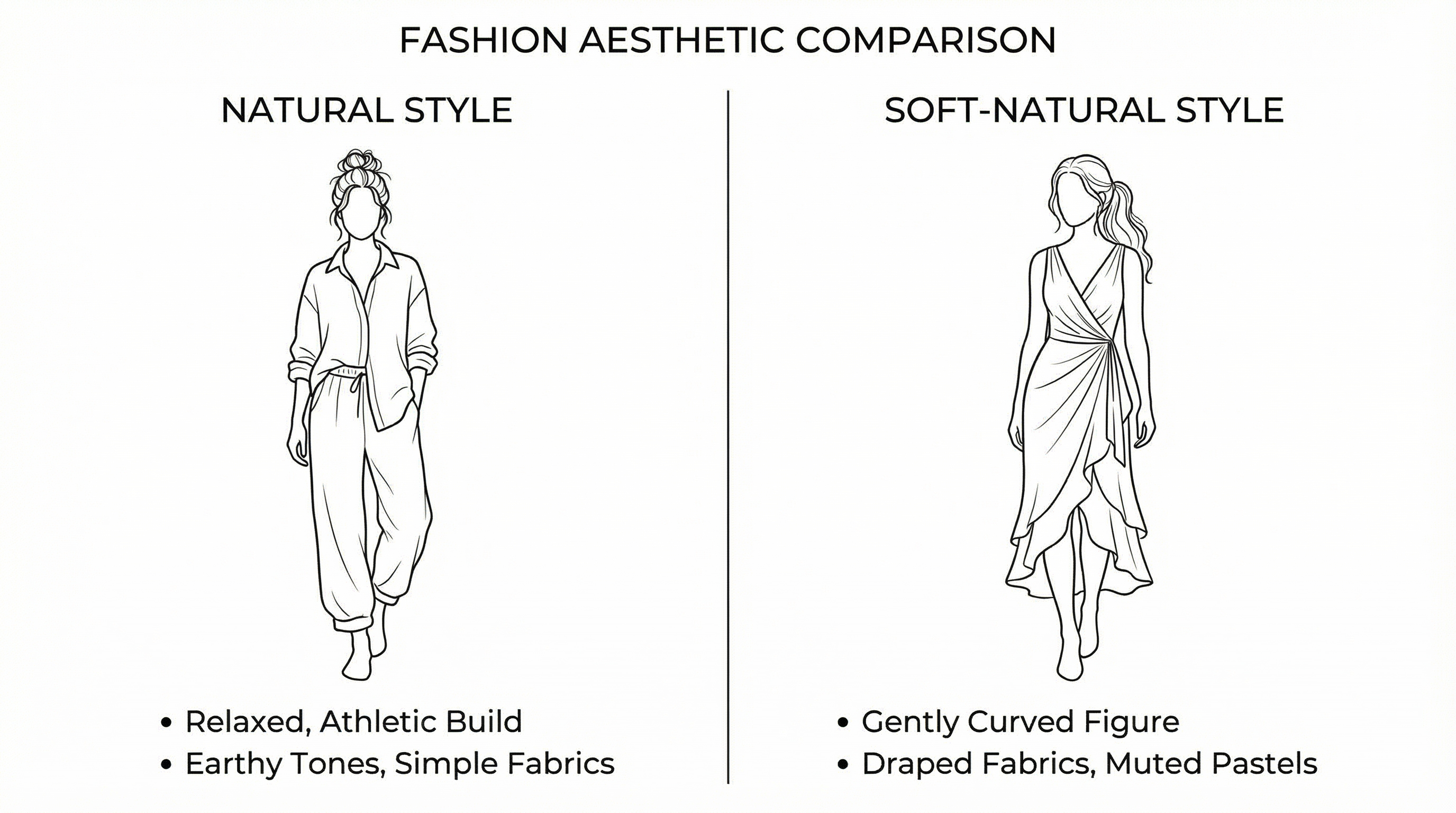
The difference between Natural and Soft Natural comes down to one element: the degree of yin softness in the flesh. Both types share the Natural family's signature width and blunt bone structure, but Soft Naturals have a romantic undercurrent that Pure Naturals lack. Understanding this distinction helps you fine-tune your style approach and choose between the slightly different recommendations for each type.
Soft Natural
Soft Yang
Approachable and feminine. Soft Naturals blend the Natural's relaxed bone structure with soft, curved flesh.
Full Soft Natural GuideNatural
Balanced Yang with bluntness
Effortlessly relaxed. Naturals have moderate frames with blunt, slightly angular bones.
Full Natural GuideWhy Soft Natural and Natural Get Confused
These types are confused because they share the same fundamental bone structure—the blunt, slightly broad Natural frame. The difference is subtle: how much yin softness overlays that frame. Pure Naturals have a more athletic, straightforward build. Soft Naturals have noticeable curves and softness that gentle their frame. Since both need to accommodate width and wear relaxed silhouettes, the styling differences can seem minor—but they matter for achieving your best look.
The Key Difference
The key difference is the presence or absence of yin flesh. Pure Naturals have moderate flesh that's evenly distributed without creating pronounced curves. Their silhouette tends toward straight or slightly rectangular, with an athletic quality. Soft Naturals have soft, curvy flesh that creates a gentle hourglass or rounded quality. Their silhouette has noticeable curves even though the underlying frame is the same as a Pure Natural. In Kibbe's original system, this means Pure Naturals are balanced yang with bluntness, while Soft Naturals are yang with a yin undercurrent.
Bone Structure: The Foundation
Both types share Natural bone structure: moderate vertical line, blunt bone edges, slightly broad or wide shoulders, and a sturdy frame that's neither delicate nor extremely angular. You'll see width in both types—this is the defining characteristic of the Natural family. The bone structure itself won't help you distinguish between these two types because it's essentially the same. You need to look at the flesh.
| Soft Natural | Natural |
|---|---|
Moderate vertical line | Moderate vertical line |
Slightly wide shoulders | Slightly broad shoulders |
Blunt bone edges | Blunt bone edges |
Moderate frame | Moderate hands and feet |
Slightly square silhouette | Square or rectangular frame |
Body Flesh and Curves
This is where the distinction lies. Pure Natural flesh is moderate and evenly distributed. There's no pronounced curve at the bust or hips—the body tends toward a straighter silhouette. The flesh may have a slightly muscular or athletic quality. Think "straight" and "sporty." Soft Natural flesh is noticeably soft and curved. You'll see gentle curves at the bust and/or hips, a more defined waist, and overall softness. The flesh may appear fleshy or rounded rather than athletic. Think "soft curves" over a sturdy frame.
| Soft Natural | Natural |
|---|---|
Soft, curved flesh | Moderate, even distribution |
Gentle curves at bust/hips | Slightly muscular |
Soft arms and thighs | Straight hips |
Slightly fleshy waist | Not overly curvy |
Rounded overall | Athletic tendency |
How to Tell Which Type You Are: Quick Tests
Stand in front of a mirror in form-fitting clothing. Look at your overall silhouette. Is it relatively straight with subtle curves, if any? That's Pure Natural. Does it show noticeable curves—a defined waist, rounded hips or bust? That's Soft Natural. Consider your arms and thighs. Do they look relatively straight and possibly muscular? Pure Natural. Do they look soft and rounded? Soft Natural. Think about which fabrics you prefer: Pure Naturals often gravitate toward more textured, substantial fabrics (chunky knits, denim, leather). Soft Naturals often prefer softer, flowing fabrics (jersey, soft cotton, gentle knits) that honor their curves.
Celebrity Comparison: Seeing the Difference
Compare Jennifer Aniston (Pure Natural) with Jennifer Lopez (Soft Natural). Both are in the Natural family, both have that characteristic width and need for relaxed silhouettes. Jennifer Aniston has the straighter, more athletic build of a Pure Natural. Her body tends toward rectangular, without pronounced curves. She looks amazing in simple, relaxed pieces—jeans and a tee, casual blazers, unfussy elegance. Soft, romantic details would look out of place on her. Jennifer Lopez has the same Natural width but with obvious curves layered over it. Her build is softer, rounder, more hourglass. She looks amazing in pieces that honor both her width AND her curves—soft flowing fabrics, gentle draping, and relaxed fits that still show her shape.
Soft Natural Celebrities
Scarlett Johansson
Gigi Hadid
Jennifer Lopez
Kate Winslet
Sydney Sweeney
Natural Celebrities
Jennifer Aniston
Meg Ryan
Drew Barrymore
Lauren Bacall
Brooke Shields
Diane Keaton
Common Mistakes to Avoid
The most common mistake is overthinking width versus softness. Both types need to accommodate width—that's non-negotiable for the Natural family. The question is simply: do you ALSO need to accommodate soft curves? If yes, you're Soft Natural. If your flesh is more moderate and athletic, you're Pure Natural. Another mistake is thinking Soft Natural is "just Natural with weight gain." Soft Natural is a distinct type with yin flesh regardless of weight. A slender Soft Natural will still have soft flesh and visible curves; a heavier Pure Natural will gain weight but still have that straighter, more athletic flesh quality.
How Styling Differs Between These Types
Pure Naturals can go more minimal and straight-lined within the relaxed Natural silhouette. Substantial fabrics, simple shapes, and unfussy details work well. There's less need to emphasize curves because there aren't dramatic curves to emphasize. Soft Naturals need to add softness and gentle curve accommodation to their relaxed silhouettes. Flowing fabrics, soft draping, and pieces that show the waist work better than the very straight, minimal look that suits Pure Naturals. The width still needs accommodation, but so do the curves.
Soft Natural Style Recommendations
- Relaxed, draped fits
- Soft, flowing fabrics
- Gentle curves (not tight)
- Unconstructed jackets
- Casual elegance
- Soft layers
Natural Style Recommendations
- Casual, relaxed silhouettes
- Natural fabrics
- Minimal fuss
- Comfortable fits
- Simple, clean lines
- Layered looks
Frequently Asked Questions
Still Not Sure Which Type You Are?
Our AI-powered Kibbe body type test analyzes your proportions from photos and can help determine whether you're a Soft Natural or Natural in just minutes.
Take the Kibbe Body Type Test